
A foundation plan is one of the most important construction drawings in architectural and structural engineering. It illustrates the footings, columns, foundation walls, and structural supports that carry loads safely into the soil. Whether you’re planning a residential home foundation, a commercial building project, or an industrial facility, understanding foundation plans is critical.

A foundation plan is a crucial construction drawing that defines the layout of footings, columns, and structural supports, ensuring the safety, stability, and strength of a building’s foundation. Its primary purpose is to guide contractors and engineers with accurate structural details, helping them execute construction with precision. By showing exact dimensions, reinforcement requirements, and load transfer points, a foundation plan prevents structural failure, cracks, and settlement issues.
The importance of a foundation plan goes beyond stability it also improves coordination between architects, civil engineers, and builders, ensuring that the project complies with local building codes, soil bearing capacity, and safety standards. A well-prepared foundation plan helps prevent unnecessary rework and added expenses, reduces construction delays, and ensures the long-term durability and reliability of the structure. In modern construction, having a detailed and professionally designed foundation plan is not just beneficial it is essential for achieving structural integrity, cost efficiency, and sustainable building practices.
A foundation plan drawing is more than just a structural layout; it is a practical tool that guides every stage of the construction process. Its applications are crucial for ensuring accuracy, safety, and efficiency on-site:
Load Distribution Analysis – Foundation plan drawings show how structural loads will be transferred safely to the soil, preventing settlement or structural failure.
Excavation and Layout Guidance –Contractors use foundation plans to mark exact footing positions, depths, and dimensions, ensuring precise excavation and site preparation.
Structural Coordination – They serve as a communication bridge between architects, engineers, and builders, avoiding conflicts between structural and architectural elements.
Material Estimation and Cost Planning – By specifying footing sizes, reinforcement details, and concrete requirements, foundation drawings help in accurate material takeoffs and budgeting.
Compliance with Building Codes – Foundation plans document essential specifications that ensure the project meets local building regulations and safety standards.
Quality Control and Inspections – Inspectors rely on these drawings to verify alignment, reinforcement placement, and depth of foundations during construction.
Error Prevention and Time Savings – A well-detailed foundation plan reduces mistakes on-site, streamlines workflow, and speeds up construction timelines.
- Footing types & sizes (isolated, strip, raft).
- Foundation wall thickness & reinforcement details.
- Column and pier locations. – Slab details.
- Excavation depth and soil-bearing notes.
- Material specifications (concrete grade, waterproofing).
- Orientation, scale, and reference sections.
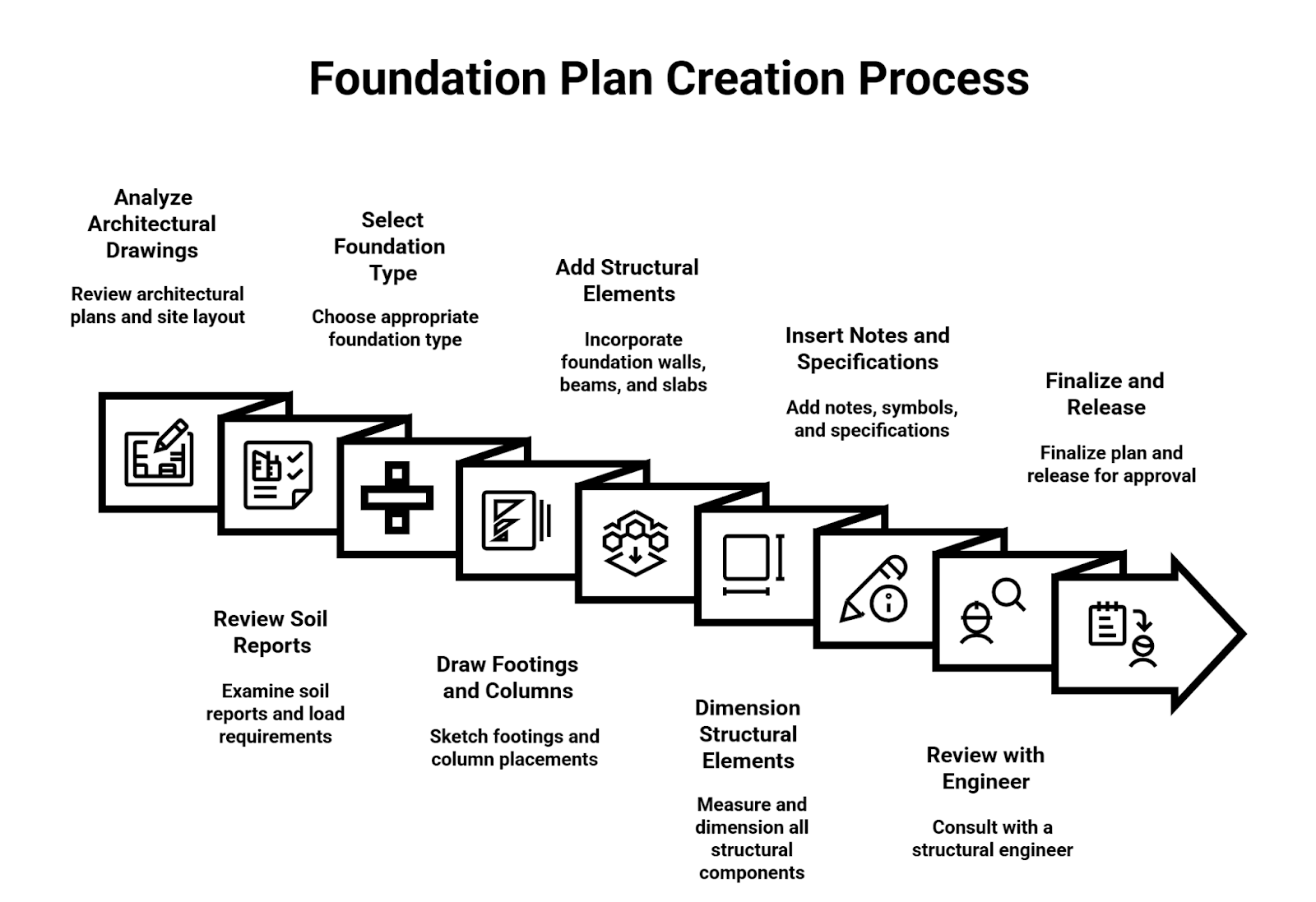
- Analyze architectural drawings and site layout.
- Review soil reports and load requirements.
- Select foundation type (shallow, deep, raft, pile).
- Draw footings and column placements.
- Add foundation walls, beams, and slabs.
- Dimension all structural elements.
- Insert notes, symbols, and specifications.
- Review with a structural engineer.
- Finalize and release for construction approval.

Understanding the difference between a floor plan, a foundation plan, and a basement plan is essential for smooth construction planning. Each serves a unique purpose and guides specific stages of building design:
- Floor Plan:
A floor plan shows the layout of rooms, doors, windows, and furniture within a building. It is primarily architectural and focuses on the functional use of space. Floor plans are critical for interior design, space utilization, and planning electrical, plumbing, and HVAC systems. Learn more about our Architectural BIM services for detailed floor planning solutions. - Foundation Plan:
Foundation plans are structural drawings that detail footings, columns, slabs, and load-bearing walls, ensuring the building’s stability and safety. Unlike floor plans, foundation plans focus on transferring loads to the ground and preventing structural failures. Explore our Structural BIM services for expert foundation planning and design. - Basement Plan:
Basement plans combine elements of both floor and foundation plans but focus on below-ground construction. They include details about basement walls, waterproofing, footing depths, and drainage. Basements require precise planning to avoid water infiltration and structural issues. Check out our Scan to BIM for accurate basement plan conversion.
While a floor plan guides the functional layout, a foundation plan ensures structural integrity, and a basement plan addresses underground construction challenges. Integrating all three with professional BIM services helps avoid high-impact construction issues and ensures a robust, code-compliant structure.
1. Why is a foundation plan important?
It ensures structural safety, stability, and durability of a building while helping contractors avoid costly mistakes and comply with building codes.
2. Who prepares a foundation plan?
Foundation plans are usually prepared by civil engineers or structural engineers, often in coordination with architects.
3. What details are included in a foundation plan drawing?
A typical foundation plan includes footing sizes, column locations, foundation walls, reinforcement details, slab thickness, and excavation depth.
4. Can a foundation plan be changed after construction starts?
Yes, but changes must be reviewed and approved by an engineer to ensure safety, stability, and compliance with codes.
5. What tools are used to create a foundation plan?
Engineers use AutoCAD, Revit, STAAD, and other CAD software, along with manual drafting techniques, to create foundation plans.
6. Does every building need a foundation plan?
Yes. Whether it’s a small house or a large infrastructure project, a foundation plan is essential for safe and stable construction.
7. What happens if a foundation plan is poorly designed?
A weak or inaccurate foundation plan can cause structural cracks, uneven settlement, and even building collapse, making professional planning critical.
Understanding and preparing accurate foundation plans is critical for any construction project, whether residential, commercial, or industrial. A detailed foundation plan ensures structural stability, precise load distribution, and seamless coordination between architects, engineers, and contractors. When combined with floor plans and basement plans, it provides a complete blueprint for safe, efficient, and high-quality construction.
At Clove Technologies, we specialize in turning your architectural and structural drawings into fully coordinated BIM models. Our services include Architectural BIM, Structural BIM, and Scan to BIM, ensuring accuracy, compliance, and efficiency at every stage of your project.
Want to see how professional BIM and digital construction solutions can elevate your foundation, floor, and basement planning? Let’s schedule a consultation with us today.
Discover more of our innovative blogs

In-House vs. Outsourced CAD Drafting: Which Is Right for Your Business?

Chenab Bridge: BIM Technology Behind India’s Most Iconic Engineering Feat
Complete Foundation Plan Guide: Purpose, Applications & Steps

AI for BIM
Let's Talk
Let’s discuss your requirements and see how our expertise can help on your next project.