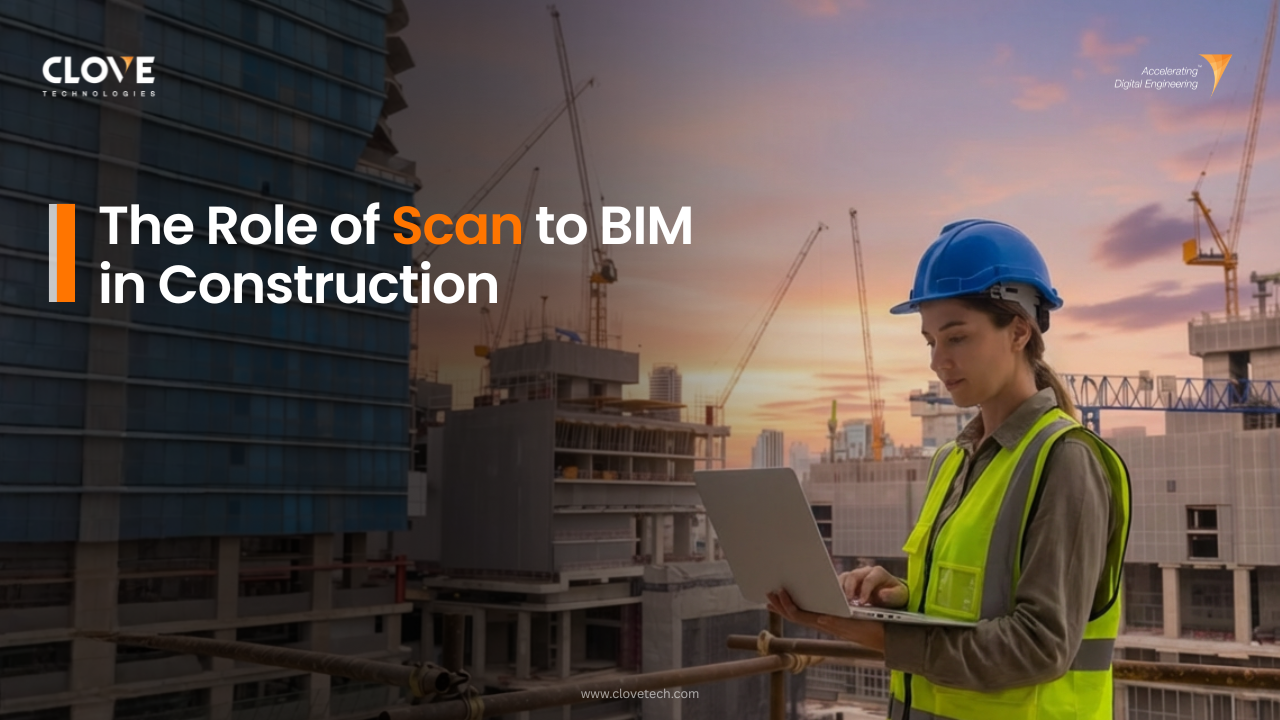
The construction industry is undergoing a significant shift, driven by digital technologies that improve efficiency, reduce risks, and enhance project outcomes. Among these innovations, Scan to BIM has emerged as one of the most impactful tools for modern construction workflows. By converting real-world building conditions into accurate digital representations, Scan to BIM in construction is enabling better decision-making, precise planning, and improved collaboration throughout the project lifecycle.
Today, advanced 3D Laser Scanning and modeling technologies allow contractors, architects, and engineers to work with detailed data that was once difficult or impossible to obtain. As a result, organizations across the world including those managing renovation, retrofit, and complex infrastructure projects are increasingly adopting Scan to BIM in Construction to support digital transformation initiatives.
The shift from traditional construction practices to digital workflows begins with accurate building data. Scan to BIM services provide this foundation by capturing existing structures with exceptional accuracy and converting them into intelligent BIM models. This transformation is bringing significant improvements across several key areas
Enhancing Accuracy Through Laser Scanning for BIM
Conventional measurement methods often involve manual surveying, which can lead to discrepancies and time-consuming corrections. In contrast, laser scanning for BIM uses high-precision 3D laser scanning devices to generate a point cloud that captures every detail of walls, floors, utilities, equipment, and structural elements. This high level of accuracy minimizes errors, reduces rework, and provides teams with reliable information early in the process.
Supporting BIM for Renovation Projects
Renovation and retrofit projects frequently face challenges due to outdated drawings or missing documentation. BIM for renovation projects solves this problem by using precise Scan to BIM workflows to create accurate as-built models.
This offers multiple advantages like
• Clear visibility of existing conditions
• Improved space planning
• Accurate clash detection
• Seamless integration of new MEP, structural, or architectural components
By integrating modern BIM technology with real-world building data, construction teams can make informed decisions and avoid issues during renovation execution.
Improving Collaboration and Project Coordination
Digital coordination is essential in large-scale projects. Scan to BIM in construction promotes better collaboration by allowing all stakeholders to work on the same accurate model. Designers, engineers, contractors, and fabricators can review existing conditions, assess constraints, and plan installations with a unified approach. This significantly enhances communication, reduces conflicts, and ensures smooth project execution.
Enabling Efficient Construction Planning and Management
The Role of BIM in construction management has expanded significantly over the years, and Scan to BIM strengthens this role even further. BIM managers and project planners benefit from
• Accurate as-built models
• Enhanced scheduling and sequencing
• Precise quantity estimation
• Better risk forecasting
• Data-driven project controls
With reliable data, teams can develop more efficient construction schedules, detect potential delays early, and maintain tighter control over project progress.
Supporting Digital Twin and Facility Management Initiatives
As buildings become smarter, Scan-to-BIM in construction plays a crucial role in developing digital twins’ virtual replicas of real assets used for monitoring and maintenance. Facility teams gain reliable information about mechanical, electrical, and architectural components, enabling proactive management and accurate lifecycle assessments.
When partnering with a Scan to BIM services provider, organizations can expect a streamlined workflow that transforms real-world conditions into a digital BIM environment. Here are the key deliverables and processes involved
Comprehensive On-Site Data Capture
Providers use advanced 3D laser scanning equipment capable of capturing millions of data points in minutes. The result is a detailed point cloud that reflects the exact geometry and conditions of the site.
Point Cloud Processing and Registration
The scanned data is cleaned, aligned, and processed to ensure accuracy. This step is essential to creating a reliable foundation for modeling.
High-Accuracy As-Built Modeling
Using Revit and other BIM platforms, technicians convert the point cloud into an intelligent as-built model. These models include architectural elements, structural components, and MEP systems depending on project requirements.
This modeling supports multiple needs like
• Construction planning
• Renovation design
• Fabrication
• Clash detection
• Space management
One of the key advantages of Scan-to-BIM Services in construction is its quality assurance workflow. Models are thoroughly reviewed for accuracy, compared with point cloud data, and validated to meet client specifications.
Depending on the engagement, deliverables may include
• BIM models (LOD 100–500)
• Point cloud files
• As-built plans
• Clash detection reports
• Construction-ready documentation
• Facility management models
These deliverables help project teams work smarter, faster, and with fewer risks.
The rapid digitalization of construction demands tools that bridge the gap between physical conditions and intelligent digital workflows. Scan to BIM provides this bridge, ensuring that construction teams work with real-world data right from project initiation.
From early-stage planning to facility management, the benefits include
• Improved accuracy
• Better decision-making
• Enhanced safety
• Reduced costs
• Faster project timelines
• Stronger overall project control
With these capabilities, Scan to BIM in construction is not just a technology upgrade it is a strategic investment in the future of construction.
Clove Technologies is a leading provider of Scan to BIM services, offering advanced digital construction expertise, precision modeling, and end-to-end support. With proven experience in Scan-to-BIM Services in construction, we deliver
High-quality point cloud processing
Accurate as-built modeling
Reliable coordination support
Professional execution for renovation, retrofit, and large-scale infrastructure projects
Clove Technologies combines cutting-edge technology with deep industry experience to support clients in accelerating digital transformation and achieve superior project outcomes.
Let’s Connect.
Discover more of our innovative blogs

Electrical BIM Services in Georgia for Commercial Projects

Common Plumbing BIM Issues and How to Avoid Them

AI for BIM
When Should You Use Scan to CAD Services for Existing Buildings?
Let's Talk
Let’s discuss your requirements and see how our expertise can help on your next project.