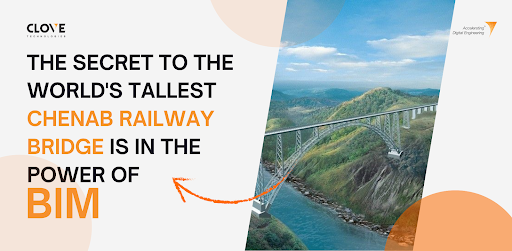
The Chenab Bridge, part of India’s Udhampur-Srinagar-Baramulla Rail (USBRL) stands 359 meters above the Chenab River in Jammu & Kashmir. At 467 meters in span, it is the world’s tallest railway arch bridge. A structure that required not just exceptional civil engineering, but a level of digital precision that traditional project delivery methods simply cannot provide.
What made it constructible wasn’t raw ambition. It was Building Information Modeling.
BIM didn’t play a supporting role here. It was the central nervous system of a project where the margin for error was effectively zero and this blog breaks down exactly how that worked, and what it means for infrastructure leaders making digital investment decisions right now.
Before examining how BIM performed on this project, it helps to understand the physical reality engineers were working against.
| Specification | Detail |
| Height above the riverbed | 359 meters (1,178 feet) taller than the Eiffel Tower |
| Arch span | 467 meters across a deep Himalayan gorge |
| Steel used | Over 25,000 tonnes of fabricated steel |
| Wind resistance | Engineered for speeds up to 266 km/h |
| Seismic designation | Zone V:India’s highest seismic risk classification |
Building in a seismically active, geologically complex, and physically inaccessible gorge was not merely an engineering challenge. It was a precision and coordination problem at a scale most infrastructure frameworks are not designed to handle.
That’s precisely where BIM came in and why it was non-negotiable.
Mega-infrastructure projects globally exhibit a well-documented pattern of failure. A McKinsey analysis of large-scale infrastructure projects found that nine out of ten come in over budget, with average cost overruns exceeding 80 percent of the original estimate. The root causes are rarely technical incompetence. They are coordination failures, design conflicts discovered late in construction, and decisions made on incomplete or outdated information.
Reworking the cost of correcting what was built wrong drives a disproportionate share of those overruns.
In standard accessible terrain, rework is expensive. At 359 meters above an active river gorge in the Himalayas, rework isn’t just expensive. It is operationally catastrophic.
The Chenab project leadership understood this from the outset. The decision to go digital-first to build the bridge virtually before a single component was fabricated wasn’t a technology preference. It was a risk management imperative.
-
1. 3D Modeling and Scan-to-BIM: Building the Bridge Digitally Before Physically
The Chenab gorge isn’t surveyable by conventional means. The terrain is remote, access is restricted, and traditional field surveying becomes less accurate as site complexity increases.
Scan-to-BIM resolved this. Using high-resolution LiDAR scanning, a standard documented by the American Society of Civil Engineers, the team captured precise point-cloud data of the gorge geometry and rock formations. That data was converted directly into a BIM environment, giving engineers a millimeter-accurate digital replica of the site before design finalization.
The 467-meter arch geometry was then optimized against this real terrain model, not designed in isolation. The fit is precise because the design process was grounded in actual site data, not approximations.
What this delivered:
- Arch geometry was tested against real gorge topology before steel fabrication began
- Foundation anchor points validated digitally, eliminating excavation-phase surprises
- Physical surveyors exposure to hazardous terrain was significantly reduced
- Design errors caught at the model stage, where correction costs a fraction of field rework
2. BIM Simulations for Construction Sequences: Planning Every Lift Before It Happens
Getting 25,000 tonnes of fabricated steel to a Himalayan gorge and assembling it in the precise sequence at correct tolerances, with the right equipment, in constrained weather windows is a coordination problem that project scheduling software alone cannot solve.
The Chenab arch was assembled from pre-fabricated segments, each transported through mountain terrain and lifted into position. The sequence of installation directly affected the structural forces acting on the arch during construction. An out-of-sequence installation could create unsafe intermediate structural states.
4D BIM, the integration of construction scheduling with the 3D model, allowed the entire assembly sequence to be simulated before work began. The Construction Industry Institute has documented that simulation-based sequencing reduces schedule overruns by up to 40% on complex infrastructure projects.
What 4D simulation enabled:
- Every segment installation is sequenced and validated virtually before site execution
- Crane positioning and rigging configurations were modeled and conflict-tested in advance
- Fabrication, transport, and assembly timelines synchronized against the live model
- High-risk lift protocols are designed around specific configurations consistent with OSHA construction safety standards rather than generic procedures
- Weather window constraints factored into activity sequencing across Himalayan seasons
3. Structural BIM Analysis and Clash Detection: Engineering for Conditions Without Precedent
The Chenab Bridge sits in Seismic Zone V, India’s highest designation. It faces sustained wind loads of 266 km/h, seasonal thermal expansion across significant temperature ranges, and repetitive dynamic railway loads across its entire operational life.
Clove Technologies Structural BIM services apply the same integrated analysis approach used on projects at this complexity level, where disconnected software environments create reconciliation risk that integrated models eliminate.
The structural variables BIM modeled simultaneously:
- Seismic scenarios: Hundreds of Zone V earthquake simulations across design-basis and extreme events
- Wind load dynamics: Gusts, sustained pressure, and crosswind turbulence at gorge elevation
- Thermal movement: Arch geometry and bearing design validated for seasonal steel expansion and contraction
- Fatigue analysis: Long-term material behavior under repetitive railway traffic loads aligned with Indian Railways Bridge Manual standards
- Foundation-rock interaction: Seismic response behavior at the critical steel-to-Himalayan-rock anchor interface
Advanced clash detection ran continuously within the model, flagging conflicts between steel members, anchorage systems, and foundation geometry before they became field problems. Changes to one variable are propagated across the integrated model automatically, eliminating the reconciliation burden that disconnected analysis workflows create.
4. BIM for Stakeholder Collaboration: One Model, One Source of Truth
The Chenab project involved structural engineers, geotechnical specialists, seismic analysts, steel fabricators, logistics teams, and on-site construction crews, often working from different locations across a multi-year timeline.
Without a unified model, version conflicts are not a risk on projects of this coordination complexity. They are a certainty.
The building SMART International BIM standards framework, the globally recognized reference for open BIM data environments, establishes exactly the kind of Common Data Environment (CDE) governance that Chenab required. Every stakeholder accessed the same model version. Every design change was logged with context. Every discipline worked from a single source of truth.
Clove Technologies collaborative BIM workflows apply this same governance architecture across multi-agency infrastructure projects, ensuring coordination integrity from design through construction handover.
5. The Digital Twin: From Construction Asset to Operational Intelligence
A Digital Twin, a live, sensor-connected replica of the physical structure, now monitors the Chenab Bridge in operation. Embedded sensors feed real-time data back to the model: stress readings, vibration levels, temperature differentials, and bearing-point movement. McKinsey analysis of large-scale infrastructure projects confirms that digital twins are now considered essential tools for government infrastructure operators, enabling accurate modeling, predictive maintenance, and significantly higher ROI on critical asset investments.
Clove Technologies Digital Twin solutions bring this operational intelligence model to rail, civil, and industrial infrastructure designed during construction, not retrofitted afterward.
What the Chenab Digital Twin delivers in operation:
- Predictive maintenance: Condition-based intervention triggered by sensor data, replacing calendar-based schedules and reducing lifecycle maintenance costs significantly
- Structural health validation: Real-time response data during train crossings compared against design parameters continuously
- Safety threshold management: Automatic alerts when wind speeds, vibration, or structural movement approach defined limits, enabling proactive traffic management decisions
- Post-event structural assessment: Following seismic events or extreme weather, the Digital Twin provides engineers with response data to determine whether inspection or intervention is required
- Lifecycle extension: Data-driven decisions consistently extend functional asset life beyond what time-based maintenance programs achieve a priority identified by the European Commission’s transport infrastructure framework
The conditions at Chenab exist in varying degrees on virtually every major infrastructure project. Remote terrain. Seismic risk. Extreme climate. Multi-agency coordination. Zero tolerance for field rework.
Most projects encounter these challenges reactively. Chenab addressed them proactively, through digital simulation, before physical commitment.
The ISO 19650 standard for BIM information management, the internationally recognized lifecycle information framework, establishes the governance architecture that made this possible. Projects that implement ISO 19650-aligned environments report significantly fewer coordination failures than those relying on informal information sharing.
The four conditions where BIM proved irreplaceable at Chenab:
- Remote terrain: Digital-first planning eliminated the need for repeated physical site access during design iterations
- Extreme climate: Pre-fabrication workflows coordinated through BIM minimized weather-dependent site exposure
- High safety risk: Upfront simulation allowed every high-risk operation to be planned and validated before execution
- Complex logistics: Material flow, fabrication schedules, and construction sequences were coordinated against a single live model, not managed across disconnected systems
The Chenab Bridge proves that digital-first delivery isn’t a premium option for complex infrastructure. It is the baseline for projects where failure is not a recoverable outcome.
KPMG’s Global Construction Survey identifies rework prevention and decision quality, not drawing efficiency as the primary financial case for BIM investment at enterprise scale. The Chenab project validates that finding under the most demanding conditions the discipline has ever encountered.
Five strategic shifts the Chenab experience demands from infrastructure leaders:
- Position BIM as a risk management instrument, the ROI case is about rework prevention and informed decisions, not documentation speed
- Commission Scan-to-BIM at the project initiation site. Data accuracy at the start determines design accuracy throughout. Errors introduced early compound through every subsequent phase
- Enforce integrated structural analysis within the BIM environment disconnected workflows create reconciliation risk that integrated models eliminate entirely
- Design the Digital Twin before breaking ground, sensor placement and data architecture specified during construction outperform retrofitted post-construction monitoring systems every time
Build 4D simulation into construction planning as standard practice sequence validation in the model is not a premium add-on for complex projects. It is the baseline.
At Clove Technologies, we bring the same digital rigor applied at Chenab to AEC and railway infrastructure projects across the complexity spectrum.
Our capabilities span the full project lifecycle:
- 3D & 4D BIM Accurate modeling, construction simulations, and sequence validation
- Structural BIM Integrated seismic, wind, and load analysis within a single coordinated model
- Scan-to-BIM LiDAR-driven site capture for precise digital replicas in complex terrain
- 5D BIM Cost-linked planning that connects design decisions to budget impact in real time
- Digital Twins, continuous operational monitoring and predictive maintenance frameworks
- Geo-Intelligence Spatial data integration optimized for challenging and remote project environments
- Collaborative Tools Single-platform stakeholder coordination that eliminates version conflict across agencies
We turn engineering challenges into digital success stories from project initiation through operational asset management.
The Chenab Rail Bridge will be studied in engineering institutions for decades. But the lesson it carries for infrastructure executives isn’t primarily about arch geometry or seismic design. It is about the organizational decision to treat digital precision as non-negotiable from initial site scanning through operational asset management.
None of what was achieved at Chenab would have been possible without BIM as the intelligence layer across every project phase.
The benchmark for complex infrastructure delivery has moved. Leaders who recognize that shift early and invest accordingly in BIM capability, Digital Twin infrastructure, and data governance will consistently deliver projects that others struggle to execute.
The question isn’t whether your next project warrants this level of digital rigor.
At the scale and risk profile of modern infrastructure, the real question is what it costs you not to apply it.
If you are evaluating BIM strategy for an upcoming infrastructure project or assessing where Digital Twin fits within your asset lifecycle, connect with the Clove Technologies team we are available to walk through specific use cases relevant to your project context.
Discover more of our innovative blogs

BIM Clash Detection for Better Construction Execution

5 Benefits of Digital Twin Technology which can change the Construction Industry

ISO 19650 Certified: Clove Technologies BIM Excellence

Step-by-Step Guide to Paper to CAD Conversion
Let's Talk
Let’s discuss your requirements and see how our expertise can help on your next project.