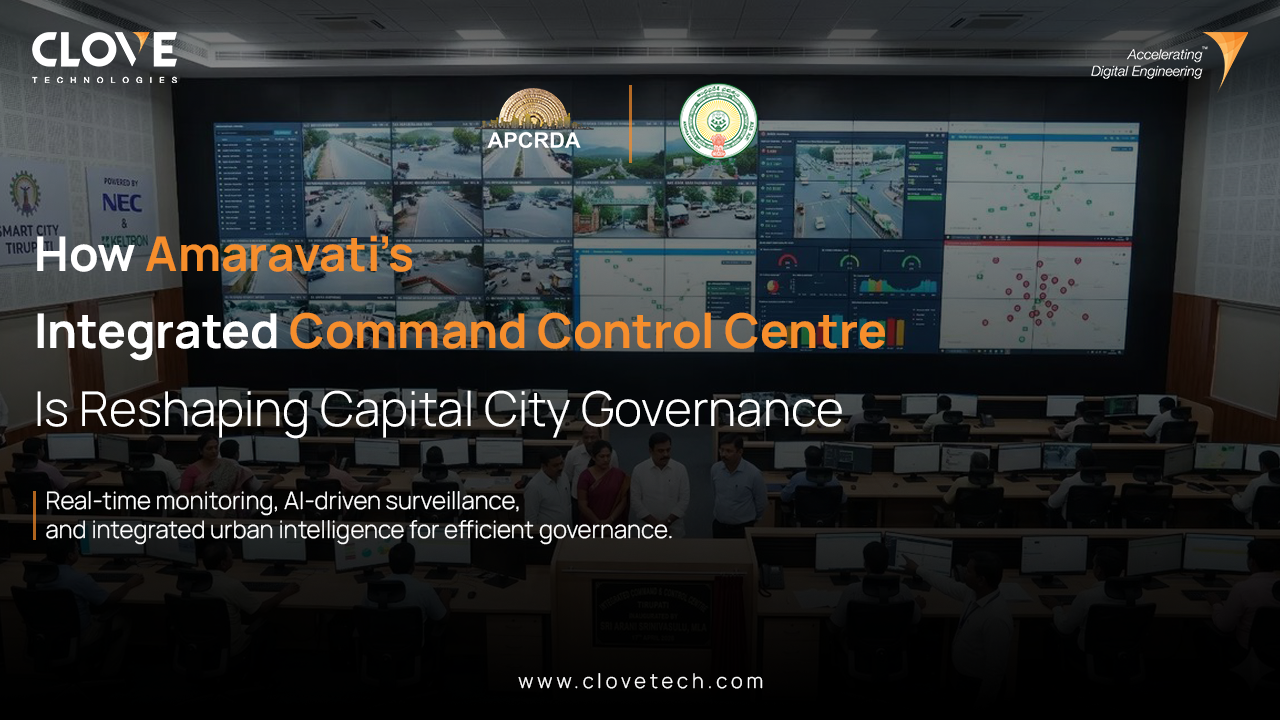
Governing a greenfield capital city demands more than political ambition and engineering capacity. It demands a system intelligent enough to hold hundreds of moving parts accountable simultaneously, in real time, and without human intervention at every step.
2026 6 min read Amaravati, Andhra Pradesh
Greenfield capital cities are rare. Cities built in the digital age with governance infrastructure designed from inception rather than retrofitted under pressure are rarer still. Amaravati, Andhra Pradesh’s new capital, belongs to that exceptional category. At its operational core sits the Amaravati Integrated Command Control Centre: a unified platform that connects construction intelligence, land records, citizen redressal, financial compliance, and spatial verification into a single, continuously updated system.
This is not a project management tool with a polished dashboard. The AICCC is the administrative nervous system of a city being built at scale one that converts fragmented data streams into decisions, and decisions into accountable outcomes.In effect, the AICCC functions as Amaravati’s city-scale digital twin a continuously updated virtual representation of the capital’s physical construction, governance workflows, and citizen systems.
· Smart City · Digital Twin · IoT / Real-Time Monitoring · BIM
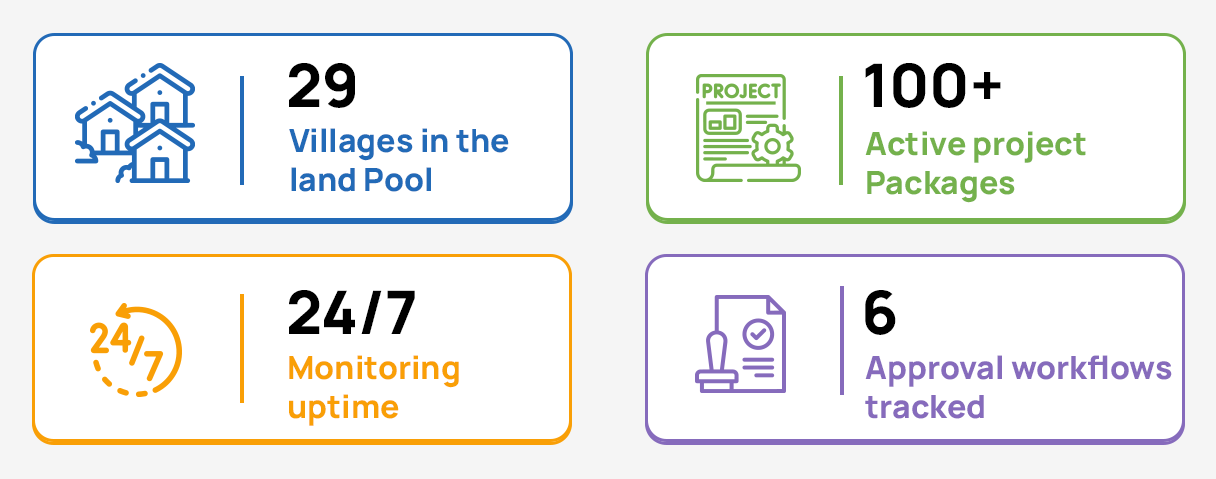
Governed by the Andhra Pradesh Capital Region Development Authority (APCRDA), Amaravati’s development spans concurrent infrastructure delivery at a scale that conventional oversight mechanisms cannot absorb. A delay in one package cascades into adjacent dependencies. An unresolved Request for Information stalls an entire construction sequence. A land record discrepancy triggers stakeholder disputes that take months to surface and longer to resolve.
Without a centralised intelligence layer, these failure points accumulate invisibly. Weekly reports arrive after the decisions they should have made. Field claims go unverified. Grievances pile up across disconnected channels. Funding conditionalities approach their deadlines without a clear read on what has actually been achieved on the ground. The AICCC exists precisely because none of that is acceptable when the asset being delivered is a functioning capital city.
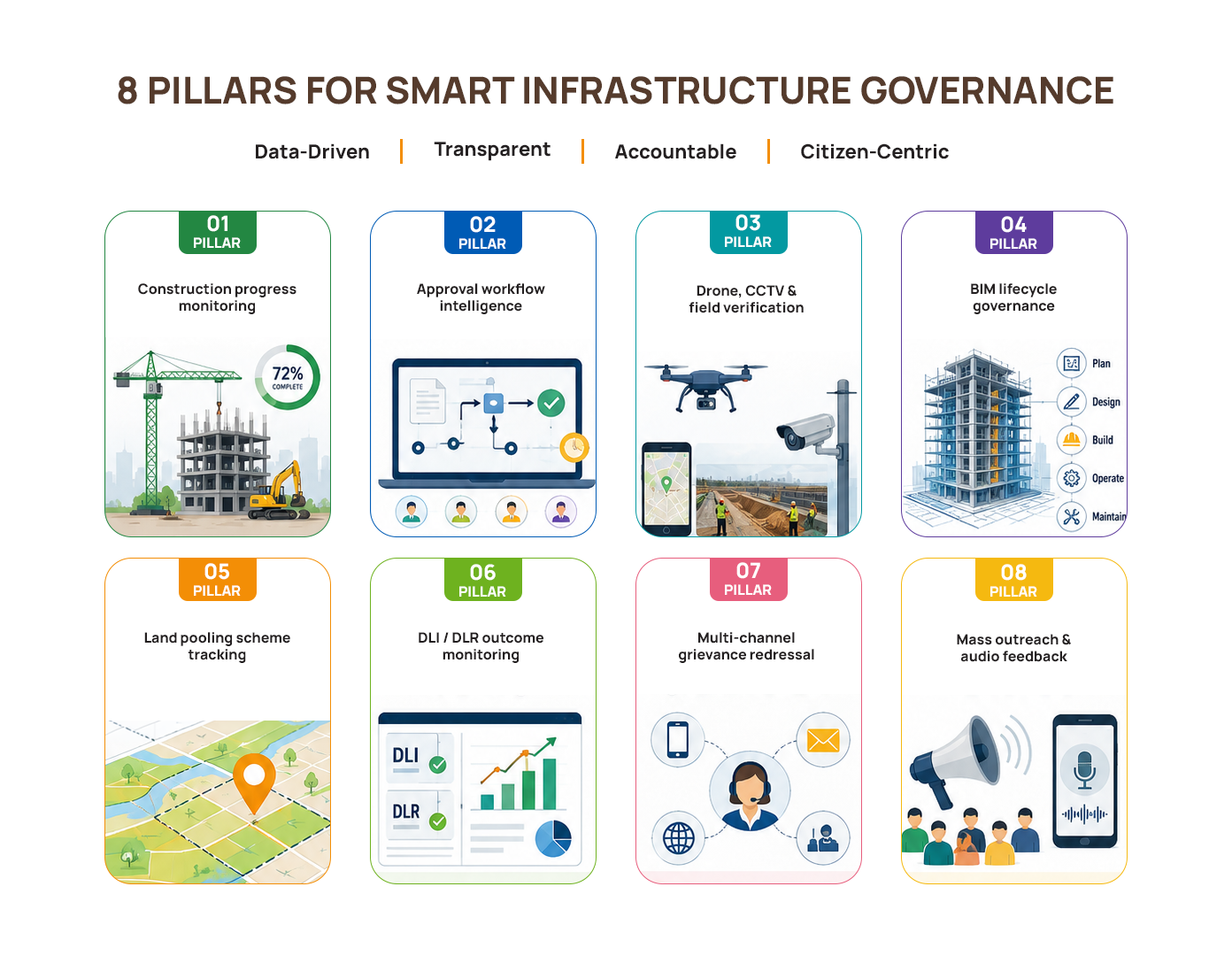
The AICCC is structured around eight integrated capability domains. Each addresses a specific governance failure that manifests in large-scale infrastructure delivery. Together, they constitute a complete operational picture from the first milestone on a construction package to the final entitlement delivered to a land-pooling farmer.
Making invisible blockers visible: construction and field verification
Across Amaravati’s active packages, arterial roads, government quarters, and drainage networks, the AICCC tracks each against its planned schedule and flags slippage before it propagates into adjacent work streams. The approval pipeline receives equal scrutiny. Every RFI, drawing submission, hindrance report, and non-conformance notice carries a defined response window; the platform monitors all simultaneously, escalating unresolved items up the reporting hierarchy automatically.
Self-reported progress is only as reliable as the incentive structure of the person reporting it. The AICCC addresses this structurally:
- Drone surveys produce orthomosaic maps and volumetric data automatically reconciled against contractor submissions discrepancies surface immediately, not during a quarterly audit
- Field engineers capture geo-tagged photographs on mobile, auto-organised by location, date, and work package
- Every blocker RFI, NCR, and hindrance is named, owned, and tracked against a hard deadline
“A single unresolved RFI can hold an entire construction sequence in suspension. The AICCC makes these invisible blockers visible and assigns them to their owners.”
How Clove Technologies built these layers
Clove Technologies entered the Amaravati programme not as a software vendor but as the governance systems architect behind the AICCC, designing each layer against a specific, documented failure mode rather than a generic infrastructure checklist:
- BIM lifecycle – 3D models update continuously as construction progresses, forming a living digital twin of each asset not a model archived at handover but a record that governs the asset through its operational life. Post-construction, water supply networks, electrical conduits, and street lighting assets are logged with installation details, warranties, and maintenance schedules, capturing institutional knowledge before engineers rotate off
- Land pooling registry – A farmer-level database across 29 villages tracking contributed plot, entitled returnable plot, development status, and handover timeline queryable in real time by the farmer, APCRDA, and oversight bodies. Designed specifically to close the information asymmetry that turns entitlement uncertainty into political grievance
- DLI/DLR compliance dashboard – Built as an operational function, not a reporting one. Programme teams see in real time which disbursement-linked indicators are achieved, which are on track, and which carry breach risk. Financing partners receive continuous, audit-ready evidence, not a periodic compiled submission
Clove Technologies built these three layers to make governance failure structurally harder to sustain than governance compliance, the engineering objective that separates a platform that governs from one that merely monitors.
Citizen engagement: governance that extends beyond the construction fence
A city under construction is also a community under pressure. The AICCC’s citizen engagement layer was built for the Telugu-speaking farmer without a smartphone, not just the administrator with a dashboard:
- Every complaint via app, web, SMS, or helpline enters a single trackable system with a unique ID, responsible department, and defined resolution SLA
- Telugu IVR campaigns reach communities without digital access, with audio-verified responses converted into quantifiable sentiment data
- Escalation is automatic when resolution timelines are breached, and citizens are not left to wonder
A city where every grievance has a ticket number and every piece of feedback has a timestamp is a city that takes its citizens seriously and can prove it to every farmer, financing partner, and oversight body that asks.
Benefits by stakeholder group
Government & administration
- Real-time construction oversight without physical presence at every site
- Automated escalation when approvals breach SLA thresholds
- Evidence-based DLI reporting is continuous, not compiled at disbursement
- Unified land records are queryable and auditable at any time
- Data-driven decisions grounded in verified operational reality
Citizens & land pool farmers
- Transparent, queryable status of land entitlements and handover timelines
- Tracked grievance resolution with a unique ID and defined response timeline
- Telugu-language IVR outreach is accessible without smartphone dependency
- Multiple access points: app, web, SMS, helpline, reducing engagement barriers
Project teams & contractors
- Single source of verified truth, removing ambiguity from progress reporting
- Approval SLA visibility prevents delays from accumulating unnoticed
- Drone-verified data that supports rather than disputes field submissions
- NCR and safety alerts surfacing compliance gaps before they escalate
What Amaravati proves about future-ready governance
Amaravati’s lasting significance is not what it demonstrates about one capital city. It is what demonstrates what becomes possible when a governance systems partner like Clove Technologies is embedded from programme inception, not called in after the cracks appear.
When Clove Technologies designed the AICCC alongside Amaravati’s physical infrastructure, the platform was not built for today’s construction programme. It was built for the city that follows it. This is the digital twin lifecycle in practice a model born in construction that matures into the operational intelligence layer of a functioning capital city:
- Traffic and mobility management absorbing real-time urban movement data into the same command infrastructure that tracked construction milestones
- Utility operations, the asset data captured during construction, becomes the live operational record governing water, power, and drainage networks post-handover
- Expanded citizen services, the grievance and outreach architecture scales from construction-phase complaints to the full spectrum of capital city governance
This is Clove Technologies model – built once, governed perpetually. The data generated during construction does not get archived; it becomes the digital twin backbone that runs the city live, queryable, and accountable.
For other cities, states, and development authorities, Amaravati is not just a reference project. It is a replicable proof point that transparency, verification, and accountability when engineered into a programme from its foundation by the right partner change not just how efficiently a city is delivered, but how much its citizens, funders, and administrators believe in it.
That compound return on a governance investment made at the right moment is precisely what Clove Technologies was built to deliver.
Governance platforms of this calibre don’t emerge from software procurement. They are designed, engineered, and embedded one capability layer at a time.
Clove Technologies designs and implements integrated command and control platforms for large-scale infrastructure programmes, smart city missions, and development authorities where accountability, speed, and verified outcomes are non-negotiable. If your programme is managing or preparing to manage the complexity that demands this level of governance, the right conversation starts before the design brief is written.
Request a capability assessment ↗ Explore the replication model ↗
Discover more of our innovative blogs

Common Plumbing BIM Issues and How to Avoid Them

10 Key Benefits of Using Electrical BIM in MEP Projects
When Should You Use Scan to CAD Services for Existing Buildings?
How ICCC Technology Is Revolutionizing Governance in Amaravati
Let's Talk
Let’s discuss your requirements and see how our expertise can help on your next project.