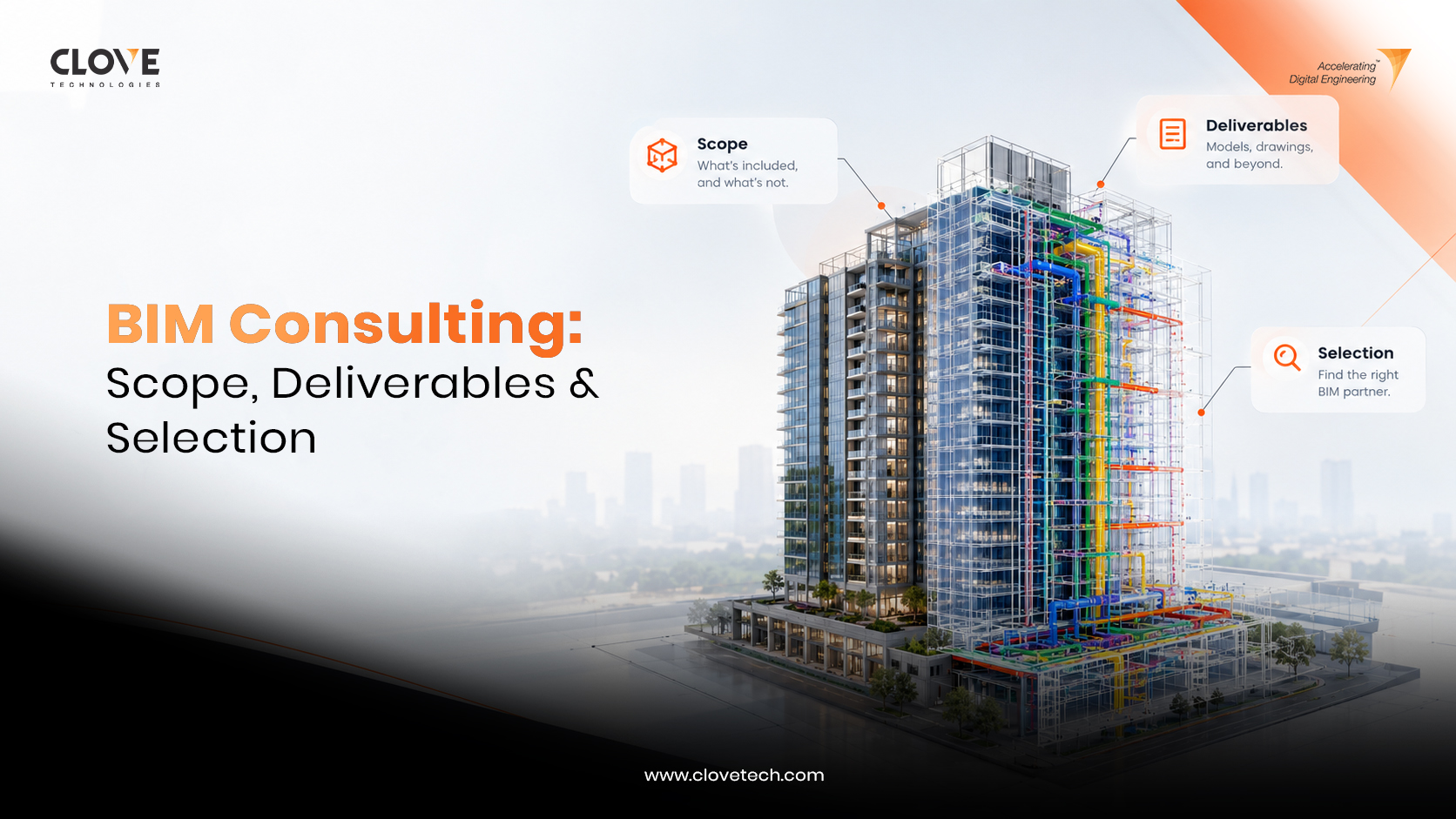
BIM consulting is no longer restricted to giving advice on setting up 3D models. For architectural, engineering, construction, infrastructure, and facility management organizations, it may even help shape the way in which project information is planned, created, coordinated, shared, and managed.
BIM consulting services can assist an organization in developing BIM standards, establishing a workflow, creating a BIM Execution Plan, and enhancing the aspect of the coordination and the usage of related technology.
But what exactly should BIM consulting include? What should a consultant deliver? And how do you choose the right BIM consultant?
This article covers the critical areas that you should evaluate when looking for a consultant.
BIM consulting is consulting in relation to the planning, implementation, management, and development of building information modeling processes. It encompasses a wide scope of services and consulting activities related to BIM but generally does not include the actual modeling and design work.
A BIM consultant may support:
- BIM strategy and implementation
- BIM Execution Plans (BEP)
- BIM standards and workflows
- Information management
- BIM coordination
- Clash detection
- Model quality assurance
- Common Data Environment (CDE) processes
- BIM technology selection
- Training and implementation support
The scope is defined according to the level of maturity of an organization’s BIM, project requirements, and specific delivery objectives.
An effective BIM consulting service supports a company’s wider business and project needs, not just its software requirements.
1. BIM Strategy and Maturity Assessment
The first step is to understand the organization’s current position.
A consultant reviews existing processes, technologies, team skills, project delivery methods, and information management practices.
The resulting strategy may define:
- Current BIM maturity
- Target BIM maturity
- Implementation priorities
- Required technologies
- Team responsibilities
- Training requirements
- Implementation roadmap
This reduces the risk of adopting BIM tools without clear business or project goals.
2. BIM Implementation
BIM implementation turns the strategy into practical workflows.
This may involve defining project processes, assigning responsibilities, setting standards, creating a collaborative work environment, and supporting teams as they adopt BIM.
A useful implementation plan should answer:
Who does what, which process should they follow, at what stage, and with what information?
3. BIM Execution Plan (BEP)
A Building Information Modeling Execution Plan (BEP) is an important deliverable for projects that use BIM. It explains how project teams will plan, create, share, coordinate, and manage BIM information.
It can define:
- BIM goals and uses
- Roles and responsibilities
- Modeling requirements
- Software requirements
- Information exchange
- Coordination procedures
- Naming conventions
- Model review processes
- File management
- Quality control
An effective BEP gives project participants a shared framework for BIM delivery.
4. BIM Standards and ISO 19650
Different project teams may create and share information in different ways. BIM consultants can establish common standards for model structure, naming conventions, information requirements, workflows, quality checks, and collaboration.
When required, consultants can also help organizations align their information management processes with the principles of ISO 19650.
5. BIM Coordination and Clash Detection
BIM coordination helps teams identify and resolve design conflicts before they become costly problems on site.
By bringing architectural, structural, and MEP models together, project teams can review how different building systems fit and work together.
Common consulting tasks include:
- Model federation
- Clash detection
- Clash classification
- Coordination meetings
- Issue tracking
- Model review
- Design validation
For example, an MEP coordination review can identify clashes between HVAC ducts and structural beams before installation begins.
6. BIM Technology and Workflow Consulting
Choosing BIM technology is only part of the solution. Consultants can assess how different tools fit into existing project workflows and support information sharing between teams.
This may include:
- BIM authoring software
- Coordination platforms
- Common Data Environments (CDEs)
- Model review tools
- Automation solutions
- Data exchange workflows
The objective should be better information flow, not simply adding more software.
I think deliverables can vary depending on the project. A professional BIM consulting engagement could contain:
| Deliverable | What it provides |
| BIM Maturity Assessment | Current-state analysis |
| BIM Strategy | Long-term BIM direction |
| BIM Implementation Roadmap | Steps for adoption |
| BIM Execution Plan | Project BIM requirements |
| BIM Standards | Consistent modeling and information practices |
| Information Requirements | Defines required project information |
| BIM Workflow | Defines information processes |
| CDE Workflow | Controls information sharing |
| Model Audit | Checks model quality and compliance |
| Clash Detection Report | Identifies coordination issues |
| Coordination Report | Tracks design coordination |
| Training Plan | Identifies required BIM skills |
Deliverables must be tied to the project goals. The work we do should directly support what the project aims to achieve. A big pile of documents does not automatically make BIM consulting better.
One of the most common misconceptions is treating BIM consulting and BIM modeling as the same service.
| BIM Consulting | BIM Modeling |
| Defines BIM strategy | Creates digital models |
| Establishes workflows | Develops model elements |
| Develops the BIM Execution Plan (BEP) | Produces project documentation |
| Defines standards | Applies modeling standards |
| Supports implementation | Updates models |
| Manages information processes | Provides model data |
| Improves BIM adoption | Supports project delivery |
A company may need BIM modeling without hiring a consultant. However, organizations that are new to BIM or want to include it in their long-term plans may benefit from both BIM modeling and expert consulting support.
Choosing a BIM consultant is not just about finding the lowest price. Start by identifying your project or organization’s needs. Then compare each consultant’s experience, skills, and track record against those requirements. This helps you find a consultant who can support your goals, not just offer a low price.
1. Look for Relevant Project Experience
Ask whether the consultant has worked on similar:
- Building types
- Infrastructure projects
- MEP systems
- Project scales
- Delivery methods
Relevant project experience is often more valuable than a general claim of BIM expertise.
2. Evaluate BIM Strategy Expertise
A good consultant should explain why a specific BIM process is suitable for your project, not just recommend software. Look for experience in BIM strategy, implementation, workflows, and information management.
3. Review Technical Capabilities
Ask the consultant to demonstrate expertise in the platforms and workflows your project needs, such as BIM authoring, coordination, Common Data Environments (CDEs), data management, and automation.
4. Ask for Clear Deliverables
Before appointing a consultant, clarify the following:
- What will be delivered?
- When will it be delivered?
- Who will review it?
- Which standards will be followed?
- How will success be measured?
Clear deliverables help prevent confusion about the project scope later.
5. Check Standards and Information Management Knowledge
If your project involves structured data, global teams, or long-term asset management, ask about the consultant’s experience withISO 19650, CDE processes, information management, and BIM governance.
6. Consider Lifecycle Capabilities
BIM does not have to end at construction.
If your organization manages completed assets, consider consultants who understand the relationship between:
BIM → Asset Information → Facility Management → Digital Twin
This approach can make BIM information more useful throughout an asset’s operational life.
A BIM consulting strategy needs to find the balance between new technologies and the specific goals of each project. Which BIM software should we use?”
ask:
“What information do we need, who needs it, when do they need it, and how should it move through the project?”
This shift from software-first thinking to information-first thinking can make BIM implementation more effective.
BIM consulting is growing beyond modeling and coordination.
Integrating BIM, GIS, reality capture, scan-to-BIM, digital construction, asset management, facility management, and digital twins creates more connected workflows.
For infrastructure, BIM and GIS can link assets with geographic data.
For operations, structured BIM data can feed into twin and asset-management workflows.
As a result, BIM consulting is increasingly becoming part of a digital transformation strategy for the built environment.
Before selecting a provider, check whether they can:
☐ Understand your BIM objectives
☐ Assess your current BIM maturity
☐ Develop a practical BIM strategy
☐ Prepare a BIM Execution Plan
☐ Establish BIM standards and workflows
☐ Support ISO 19650 requirements where applicable
☐ Coordinate multidisciplinary models
☐ Perform model QA/QC and clash detection
☐ Support BIM technology implementation
☐ Manage project information
☐ Provide relevant training
☐ Support asset and lifecycle information
☐ Demonstrate project experience
The real question is not just BIM modeling vs. BIM consulting. It is how BIM consulting can improve the way a team plans, manages, and delivers a project.
BIM modeling creates detailed digital models.
BIM consulting helps organizations build the right strategy, standards, workflows, and information management processes around those models.
Choosing the right BIM consulting service provider means looking beyond cost. Experience, methodology, deliverables, technical skills, communication, and lifecycle planning all matter.
Ready to Improve Your BIM Workflows?
Build a clear BIM strategy, improve project coordination, and connect people, processes, and technology with the right BIM consulting approach.
Discover more of our innovative blogs

Revit vs AutoCAD: Understanding the Difference in AEC Workflows

Pipe Spool Drawings vs Piping Isometrics: Key Differences

Digital Twin Software and Platforms: A Practical Guide to Features, Applications, and Selection

Step-by-Step Guide to Efficient MEPF BIM Coordination
Let's Talk
Let’s discuss your requirements and see how our expertise can help on your next project.