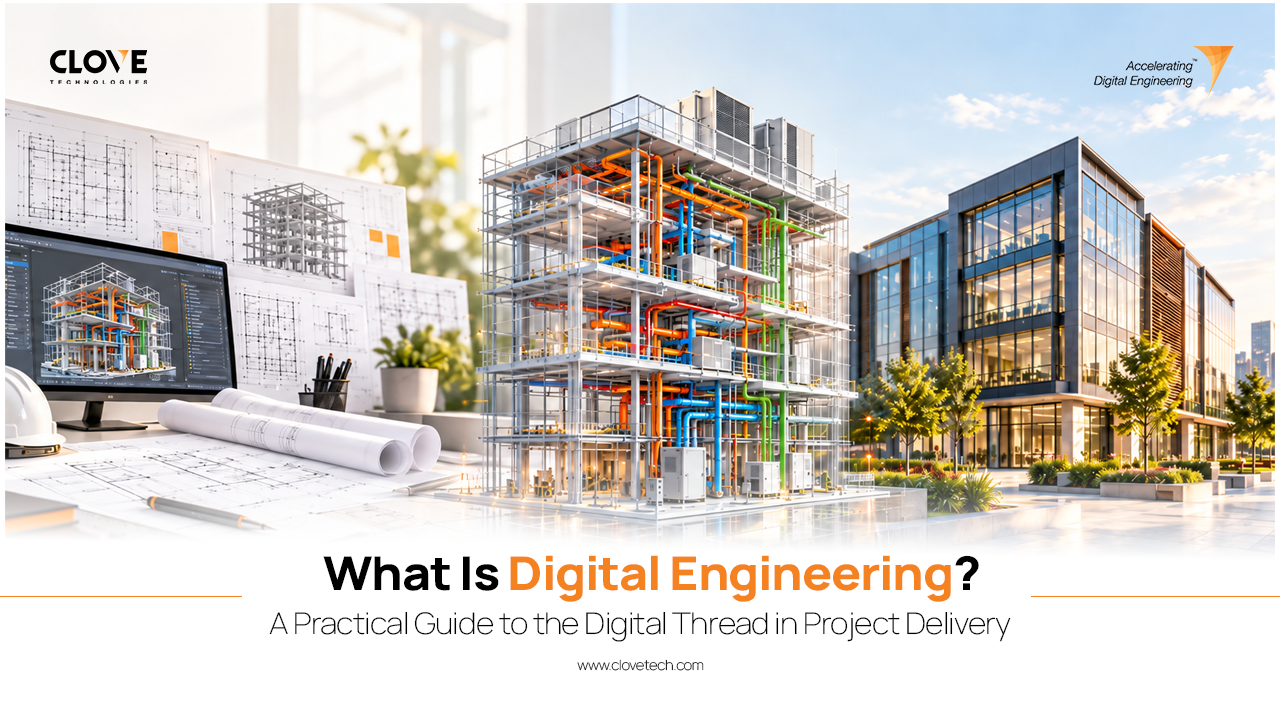
A design can be technically correct and still fail during construction. The duct is sized properly but clashes with a cable tray. The beam carries its load, but nobody planned the penetration the pipework needs. Each decision was right on its own. Together, they cause rework and delay.
The cause is rarely bad engineering. It is disconnected engineering information, spread across calculations, models, drawings and spreadsheets. Digital Engineering exists to close that gap.
Digital Engineering is an integrated approach that connects engineering expertise, design data, digital models, analysis and project information across the lifecycle of a physical asset. It lets teams design, coordinate, validate, build and operate assets using one connected, trustworthy flow of digital information.
In practice, calculations feed the model, and the model carries engineering parameters rather than just geometry. Construction and operations teams receive information they can trace back to the decision that created it. Digital Engineering is not one software platform, and it is not simply another name for BIM.
Buildings and infrastructure now pack more interdependent systems into tighter spaces, with higher performance targets and more distributed teams.
McKinsey’s Technology Trends Outlook 2026 says the technology story has moved into the physical world, and it adds AI for scientific discovery and engineering as a new trend. The report notes that spending on AI infrastructure doubled in a single year, and that energy technologies drew nearly $200 billion in investment in 2025, partly because AI needs energy to scale. It also projects that US data centers running AI workloads could use as much electricity by 2030 as California does today. The facilities behind that growth are among the hardest assets to design and build, leaving little room for coordination errors.
Most teams already use digital tools, yet information still gets lost at every handoff. A digital thread is the connected flow of authoritative data that links an asset’s information from design through construction and operation, so decisions can be traced and reused instead of recreated.
Gartner’s October 2025 research note, Digital Threads Aren’t Optional They’re Urgent for Digital Engineering and AI, argues that organisations should adopt digital threads urgently because they connect lifecycle data, enable Digital Engineering and create an AI-ready foundation (the full report is available to Gartner clients). For an openly available introduction, the US National Institute of Standards and Technology covers the concept through its Digital Thread programme. Together, they give project teams a simple sequence:
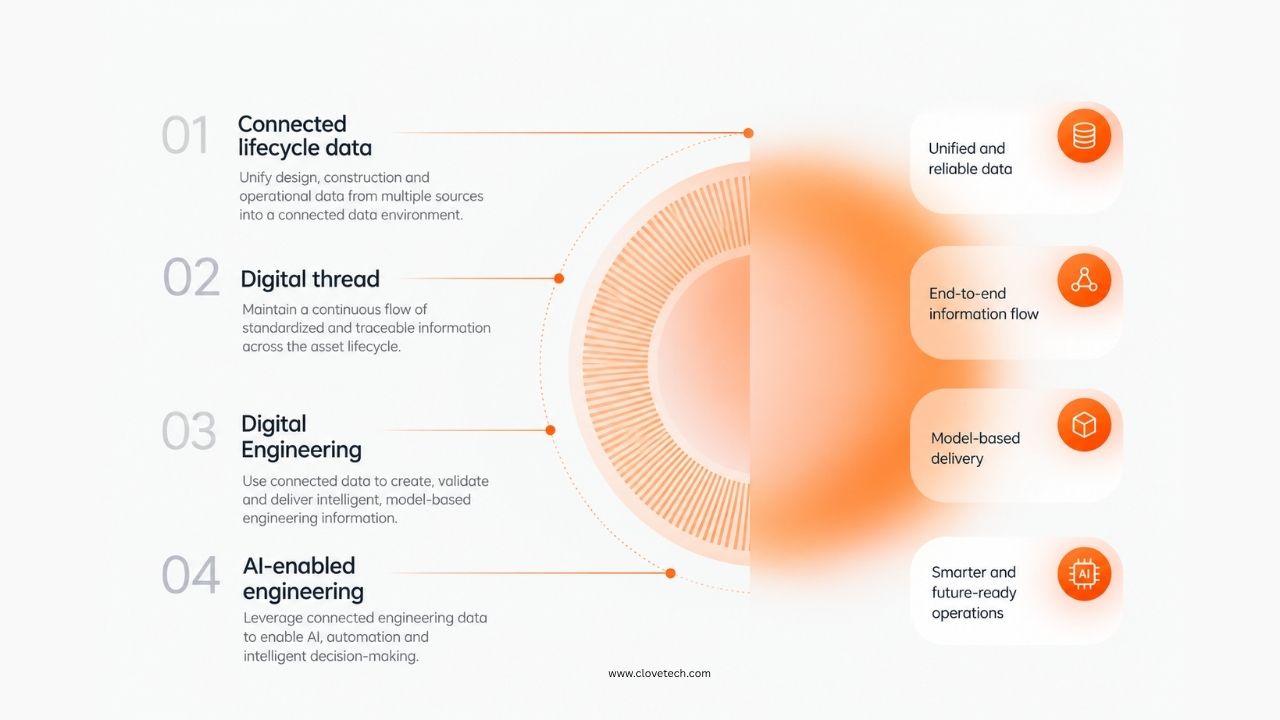
BIM is a core part of Digital Engineering, but not all of it. The ISO 19650 series defines information management using BIM across the whole asset lifecycle. Digital Engineering builds on that with engineering analysis, simulation, automation, reality capture, GIS, Digital Twins and AI. BIM shows where systems are; Digital Engineering also checks whether they will work.
|
Digital engineering design turns engineering intent into buildable information. It runs through load and system calculations, models that carry real engineering data, multidisciplinary coordination and clash detection, re-checking calculations after coordination changes, constructability review, and documentation generated from the model.
The aim is not a clash count of zero for its own sake. It is a design that works, fits, can be installed in sequence and can be maintained.
Digital Engineering Across Core Disciplines
- Mechanical & HVAC: load calculations, plant selection, and ductwork and maintenance access coordinated in the model.
- Power & Electrical: load schedules, single-line diagrams, cable sizing, ICT and ELV containment, and space for future capacity.
- Plumbing & Public Health: water, drainage and stormwater, with gravity falls protected during coordination.
- Fire Protection & Life Safety: suppression, detection and dampers coordinated with other services. Fire strategies remain the responsibility of qualified fire engineers and approving authorities.
- Architectural & Structural: agreed service zones, approved penetrations and buildable structural interfaces.
- Data Centre & Mission-Critical: redundant power and cooling paths verified as physically separate, thermal performance tested, and expansion capacity recorded.
Digital engineering tools form an ecosystem, not a single product. Typical categories include BIM authoring (Autodesk Revit, Tekla, AutoCAD), engineering analysis and simulation, Common Data Environments such as Autodesk Construction Cloud, and coordination and clash detection in Navisworks. Others are computational design and automation, GIS, reality capture (laser scanning, LiDAR, drones), Digital Twin platforms, IoT sensors, analytics such as Power BI, and AI.
Technology alone does not create Digital Engineering. Connected workflows do.
Benefits of Digital Engineering
The benefits of Digital Engineering come from information that stays connected and trustworthy:
- Better multidisciplinary coordination and earlier issue detection
- Reduced design risk and less avoidable rework
- Improved constructability
- Faster, better-informed decisions
- Stronger handover information and operational readiness
- A foundation for Digital Twins and AI-ready data
Results depend on project complexity and consistent practice; no approach removes every site issue.
Clove Technologies Digital Engineering services bring engineering expertise, analysis and digital workflows into one connected environment. Calculations, design, modelling and documentation are not handled as separate tasks; they form a continuous flow of information from concept through construction and operations.
Engineering and Modelling in One Workflow
Instead of handing calculations to a separate team to model, Clove keeps engineering and digital delivery in one workflow. This is the work of a digital engineer: sizing and checking systems, then building the models and data that carry those decisions forward. When coordination moves a duct or a panel, the engineering impact is checked straight away, not discovered on site.
Engineering Across Six Disciplines
- Mechanical & HVAC: HVAC systems engineered for performance, efficiency and maintainability.
- Power & Electrical Systems: resilient power, ICT, ELV and security systems built for reliability and future capacity.
- Plumbing & Public Health: water, drainage and stormwater systems designed for reliability and efficiency.
- Fire Protection & Life Safety: integrated systems designed for compliance and resilience.
- Architectural & Structural: coordinated architecture and structures designed for buildability and performance.
- Data Centre & Mission-Critical: resilient power, cooling and critical infrastructure engineered for continuous operations.
Digital Engineering Solutions Across the Project Lifecycle
Clove connects these disciplines with its wider digital delivery services, so each stage passes trustworthy data to the next:
- Capture: 3D laser scanning, drone surveys and LiDAR mapping record existing site and building conditions.
- Engineer and model: discipline engineering produces models that carry real design data, not just geometry.
- Coordinate: BIM coordination and clash detection resolve interfaces before work reaches site.
- Build and verify: laser scanning during construction and as-built BIM confirm what was actually installed.
- Operate: Digital Twin services support asset intelligence, IoT monitoring and predictive maintenance.
Engineering is moving from disconnected digital outputs toward connected lifecycle intelligence.
Digital Twins, intelligent operations and AI all depend on reliable, connected engineering information. Organizations that establish this foundation today will be better positioned to adopt these capabilities with greater confidence, consistency and long-term value.
Explore Clove Technologies Digital Engineering Services
What is Digital Engineering?
Digital Engineering is an integrated approach that connects engineering expertise, models, analysis and project data across an asset’s lifecycle, so design intent flows reliably into construction and operations.
Is Digital Engineering the same as BIM?
No. BIM is a core component, but Digital Engineering also connects engineering analysis, reality capture, data management and Digital Twins across the full lifecycle.
What are the benefits of Digital Engineering?
Better coordination, earlier issue detection, reduced design risk and rework, improved constructability, stronger handover information, and a foundation for Digital Twins and AI.
How is AI used in Digital Engineering?
AI supports model checking, document search, automation and prediction, but it depends on structured, connected engineering data. Qualified engineers remain accountable for design decisions.
What do Clove Technologies Digital Engineering services cover?
Mechanical & HVAC, Power & Electrical, Plumbing, Fire Safety, Architectural & Structural, and Data Centre & Mission-Critical engineering, connected with reality capture, BIM coordination and Digital Twin services.
Discover more of our innovative blogs

Architectural Design Services: What to Expect When You Outsource

Skyscraper Design: How BIM Is Transforming Modern High-Rise Construction

BIM Cost in USA (2026): Per Sq Ft Pricing, LOD Breakdown & Real Project Costs
Electrical BIM Workflow : From Design to Construction
Let's Talk
Let’s discuss your requirements and see how our expertise can help on your next project.