
BIM Engineer salary varies depending on country, experience, specialization, software proficiency, and job responsibilities. In 2026, BIM professionals can find opportunities across architecture, structural engineering, MEP, infrastructure, construction, digital twins, and facility management.
In the United States, current salary data places the average BIM Engineer salary at approximately $130,588 per year, while the average salary for a BIM Engineer I entry-level position is approximately $69,295 per year.
In India, salary ranges are broader and depend heavily on experience, location, discipline, employer, and project exposure.
However, salary is only one part of a BIM career. As professionals progress from BIM modeling into engineering, coordination, management, and specialized roles, their responsibilities and earning potential can increase. Experienced BIM experts can also contribute to complex projects, multidisciplinary coordination, and digital engineering workflows.
There is no single worldwide BIM Engineer salary because job responsibilities, experience levels, and salary structures differ between countries and organizations.
The following figures provide a general reference:
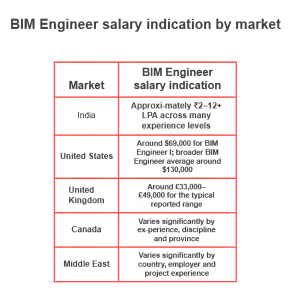
These figures should be considered indicative salary ranges rather than guaranteed salary bands. Salary sources use different methodologies, job titles, experience levels, and sample sizes, so salary comparisons between countries may not be directly equivalent.
For example, current UK salary data reports a typical BIM Engineer range of approximately £33,305–£48,538, with an average of around £40,160.
BIM Engineer salaries in India can differ significantly depending on experience, location, discipline, employer, software expertise, and international project exposure.
Recent 2026 salary data indicates that many BIM engineering positions fall within a broad range, from approximately ₹2.5 lakh per year for entry-level professionals to ₹10 lakh or more for experienced professionals. Senior BIM managers and highly specialized professionals may earn considerably more.
A general experience-based reference is:
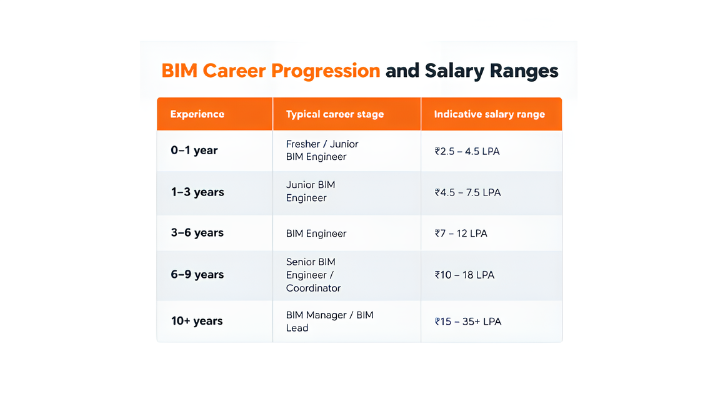
These are indicative ranges, not fixed salary bands. Actual compensation can be lower or higher depending on employer, discipline, location, project complexity, international exposure, and individual skills.
BIM Engineer Salary by Location in India
Location can influence BIM Engineer salary because major cities have a higher concentration of engineering consultancies, global AEC companies, construction organizations, and international project delivery centers.
BIM professionals can find opportunities across cities such as:
- Bengaluru
- Gurugram
- Mumbai
- Pune
- Hyderabad
- New Delhi
- Chennai
For example, recent salary data reports BIM Engineer salaries in Hyderabad/Secunderabad at approximately ₹2.4 — 8.5 lakh per year, although actual compensation varies according to experience, employer, specialization, and job responsibilities.
However, professionals should not choose a BIM career based only on location-based salary. International project experience, specialization, software expertise, and progression into coordination or management can have a significant impact on long-term earning potential.
The United States is one of the higher-paying markets for BIM professionals. However, compensation differs significantly depending on the specific BIM position and level of experience.
According to current Salary.com data, the average BIM Engineer salary in the USA is approximately $130,588 per year, with a reported 50th–75th percentile range of approximately $121,734–$143,413.
For a BIM Engineer I entry-level position, the average salary is approximately $69,295 per year, with a reported 25th–75th percentile range of approximately $63,415–$75,927.
Salary.com also reports higher compensation levels as professionals progress through BIM Engineer II and BIM Engineer III positions.
This highlights an important point:
“BIM Engineer” is not one fixed job level.
BIM Engineer compensation in the United Kingdom varies according to experience, location, discipline, employer, and project responsibilities.
Current salary data reports an average BIM Engineer salary of approximately £40,160 per year, with a typical reported range of approximately £33,305–£48,538.
Professionals who take on additional responsibilities in BIM coordination, information management, project delivery, or BIM management may progress beyond the typical BIM Engineer salary range.
BIM Engineer salary depends on much more than years of experience. Several factors can influence earning potential.
1. Experience
Experience is one of the most important factors influencing BIM salary.
A professional who has worked on multiple large-scale BIM projects will generally be able to handle more complex tasks than an entry-level professional.
A typical career progression can look like:
BIM Modeler → BIM Engineer → Senior BIM Engineer → BIM Coordinator → BIM Manager → BIM Consultant
Each step can involve greater technical responsibility, coordination, decision-making, team management, and client communication.
2. BIM Specialization
Not every BIM discipline has the same requirements or demand.
Professionals can specialize in:
- Architectural BIM
- Structural BIM
- MEP BIM
- Mechanical BIM
- Electrical BIM
- Plumbing BIM
- Infrastructure BIM
- Scan to BIM
- VDC
- Digital Twins
- BIM Coordination
MEP BIM can be particularly valuable because professionals often need to coordinate multiple building systems within constrained spaces while considering design and construction requirements.
3. BIM Software Knowledge
Knowledge of BIM softwares directly influences the types of projects and roles a professional can pursue.
Common BIM and digital construction tools include:
- Autodesk Revit
- Navisworks
- AutoCAD
- Civil 3D
- Tekla Structures
- Autodesk Construction Cloud
- Point Cloud and Reality Capture software
Among these, Revit is widely used across architectural, structural, and MEP BIM workflows.
However, simply listing software on a resume is no longer enough. Employers increasingly value professionals who can apply software knowledge to real project workflows, solve technical problems, and deliver coordinated project information.
4. BIM Coordination Skills
Moving from modeling into BIM coordination can significantly expand career opportunities.
A BIM Coordinator may need to review architectural, structural, and MEP models, identify clashes, coordinate design changes, resolve issues, and communicate solutions to project teams.
This requires a combination of:
- Technical BIM knowledge
- Engineering understanding
- Clash detection skills
- Problem-solving
- Communication
- Project coordination
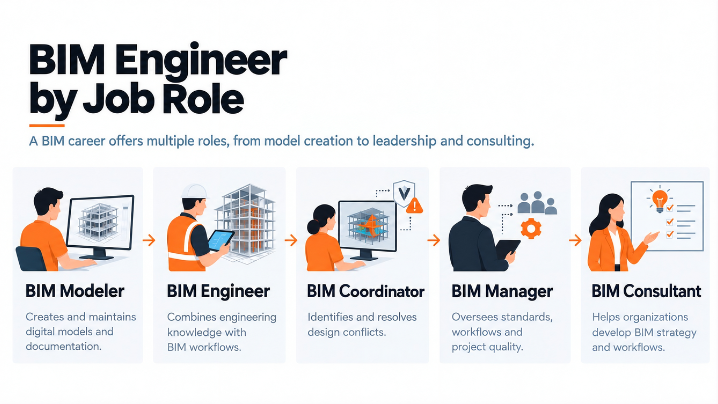
A BIM career does not end with the BIM Engineer position. Professionals can progress into several specialized and leadership roles.
BIM Modeler
BIM Modelers primarily focus on creating and maintaining digital models and project documentation.
BIM Engineer
BIM Engineers combine engineering knowledge with BIM workflows.
BIM Coordinator
BIM Coordinators work across disciplines and focus on identifying and resolving design conflicts.
BIM Manager
BIM Managers oversee BIM standards, workflows, project requirements, model quality, coordination, and BIM deliverables.
BIM Consultant
Experienced professionals can progress into BIM consulting and help organizations develop:
If salary growth is one of your BIM career goals, focus on developing skills that allow you to move beyond basic model creation.
Advanced Revit
Learn more than basic modeling. Develop knowledge of:
- Family creation
- Templates
- Parameters
- Documentation
- Modeling standards
- Discipline-specific workflows
BIM Coordination
Develop skills in:
- Clash detection
- Model federation
- Issue management
- Multidisciplinary coordination
- Model review
MEP BIM
Build knowledge of:
- HVAC
- Electrical systems
- Plumbing
- Fire protection
- Building services
- MEP coordination
BIM Standards
Understand:
- BIM project standards
- Naming conventions
- Level of Development (LOD)
- BIM Execution Plans
- Information requirements
BIM Automation
Automation skills can help reduce repetitive BIM tasks and improve workflow efficiency.
Professionals can explore tools such as Dynamo and scripting to automate repetitive processes.
Scan to BIM
Scan to BIM combines reality-capture data such as point clouds with BIM workflows to create digital models of existing buildings or facilities.
Understanding Scan to BIM can open opportunities in renovation, retrofit, as-built documentation, and existing-building projects.
Digital Twins
Digital twin workflows extend beyond traditional BIM by connecting digital building information with operational and asset data.
Professionals who understand BIM alongside asset management, monitoring, and digital twin technologies can develop additional areas of specialization.
Starting a BIM career does not require learning every BIM platform at once. A focused, practical approach is usually more effective.

BIM is becoming an increasingly important part of digital construction and the wider AEC industry.
The BIM career path is also expanding beyond traditional 3D modeling.
Modern digital construction workflows can connect:
Reality Capture → Point Cloud → BIM Model → Design Coordination → Construction → As-Built Documentation → Asset Management → Digital Twin
Technologies such as LiDAR, Scan to BIM, cloud collaboration, automation, and digital twins are creating additional opportunities for professionals who understand both BIM and emerging digital workflows.
This means future BIM professionals will increasingly need to connect engineering knowledge with digital project information.
Explore the Future of BIM
See how BIM, Scan to BIM, digital twins, and digital engineering are transforming AEC projects.
[Explore Clove’s BIM Services →]
A BIM Modeler primarily focuses on creating and maintaining digital models and project documentation.
A BIM Engineer generally has broader technical responsibilities and may be involved in engineering decisions, model development, coordination, quality control, and project delivery.
As professionals gain experience, they can progress into:
BIM Coordination → BIM Management → BIM Consulting → Specialized Digital Construction Roles
The exact career hierarchy can vary between organizations.
A BIM Engineer career can offer strong earning potential, but salary growth depends on continuous professional development and the ability to take on increasingly complex responsibilities.
Learning a BIM software platform is a useful first step, but professionals who combine engineering knowledge, BIM coordination, international project experience, automation, and emerging digital technologies can create broader career opportunities.
The important question is not only:
“How much does a BIM Engineer earn?”
It is also:
“Which skills can help me move to the next level of my BIM career?”
From BIM modeling and Revit to BIM coordination, MEP BIM, Scan to BIM, automation, and digital twins, the BIM profession continues to evolve with the AEC industry’s move toward connected digital workflows
Discover more of our innovative blogs

How MEP BIM Enhances the Design and Construction of High-Performance Buildings

What is Navisworks? A Complete Guide for BIM and Construction Professionals

Point Cloud to BIM: A Guide for Surveyors, Engineers & Contractors

Top MEP BIM Service Provider in Texas for Electrical, Plumbing & HVAC Systems
Let's Talk
Let’s discuss your requirements and see how our expertise can help on your next project.