
Digital Twin technology in construction creates a real-time digital replica of physical assets using BIM, IoT sensors, cloud computing, and AI. It helps construction teams improve project visualization, reduce costs, predict maintenance needs, optimize operations, and achieve sustainability goals throughout the asset lifecycle.
Whether it’s a commercial building, highway, bridge, industrial facility, or smart city infrastructure, digital twins empower stakeholders to make informed decisions based on accurate, real-time information. As the construction sector faces increasing pressure to deliver projects faster, safer, and more sustainably digital twins are emerging as a game-changing solution.
Considering a digital twin strategy for your next project?
Connect with Digital Twin experts to explore how GeoBIM-powered solutions can improve project visibility, operational efficiency, and long-term asset performance.
Schedule a Meeting Visit our Digital Twin Solutions page to learn more
Construction projects often face challenges such as:
- Budget overruns
- Schedule delays
- Design conflicts
- Resource inefficiencies
- Safety concerns
- Environmental compliance requirements.
Digital twin technology addresses these challenges by creating a single source of truth that enables proactive decision-making and continuous optimization.
Let’s explore the top five benefits driving adoption across the construction industry.
Digital twins follow a consistent five-stage process:
- Capture existing asset data using BIM models, drone surveys, LiDAR scanning, and IoT sensors to build an accurate picture of the physical environment.
- Build the digital model integrating geometric and operational data into a centralized digital twin platform.
- Connect real-time data streams so the model stays synchronized with structural performance, equipment health, environmental conditions, and construction progress.
- Analyze data with AI identifying trends, predicting failures, and flagging anomalies before they cause delays.
- Optimize decision-making using these insights to guide maintenance schedules, operational efficiency, and long-term asset planning.
Although Digital Twin Technology and Building Information Modeling (BIM) are closely related, they serve different purposes within the construction lifecycle.
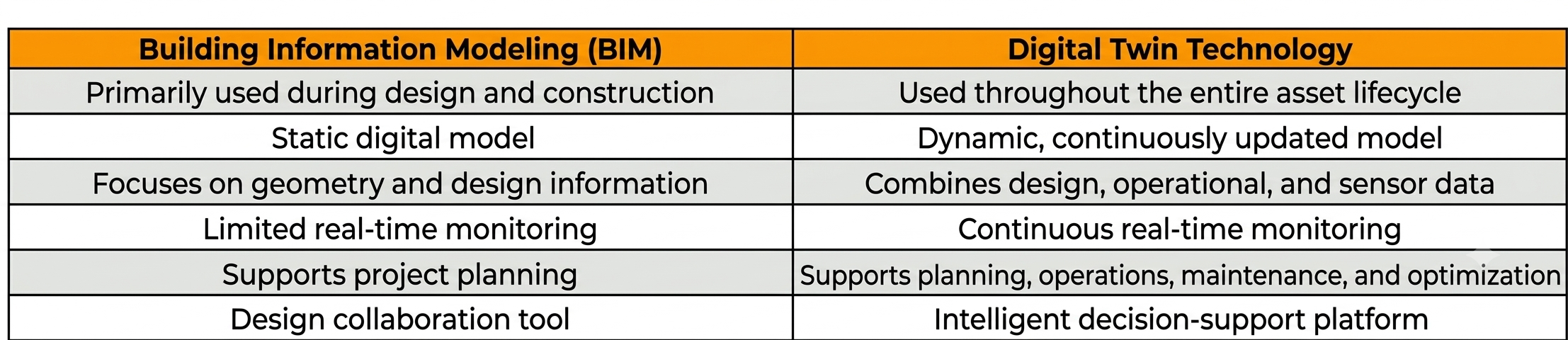
BIM provides the digital foundation for construction projects, while a Digital Twin extends that foundation by integrating live operational data. Together, these technologies create a connected ecosystem that improves visibility, efficiency, and asset performance across every phase of construction.
1. Immersive Pre-Construction Foresight
Traditional drawings and static 3D models rarely capture the full complexity of a construction project. Digital twins create an immersive, data-rich environment where teams can walk through every component of a structure before a single foundation is poured replacing guesswork with a clear, testable preview of the finished asset.
In practice: A contractor building a hospital wing can simulate MEP (mechanical, electrical, plumbing) routing against structural elements to catch clashes months before installation avoiding rework that industry research consistently links to a significant share of total project costs.
Impact: Sharper upfront planning, fewer design errors, stronger stakeholder buy-in, faster approvals.
2. A Single, Connected Project Command Center
Construction projects involve architects, engineers, contractors, suppliers, and owners — often working from disconnected systems and siloed updates. Digital twins replace that fragmentation with one connected command center where every stakeholder views the same live project data at the same time.
In practice: Instead of waiting for weekly progress reports, a project owner can log into the digital twin platform and see current construction status, flagged issues, and updated timelines instantly.
Impact: Faster decisions, fewer communication gaps, stronger accountability, greater project-wide transparency.
3. Condition-Based Asset Foresight
Once a building or structure becomes operational, its digital twin doesn’t stop working. It continues collecting performance data, allowing facility managers to monitor systems and equipment in real time and act on their actual condition rather than a fixed inspection calendar.
In practice: HVAC systems can be tracked continuously for early signs of wear, structural performance can be analyzed for long-term stress patterns, and maintenance can be triggered automatically the moment equipment condition warrants it.
Impact: Lower maintenance costs, extended asset lifespan, fewer unplanned equipment failures, stronger operational uptime.
4. Live-Data Cost and Resource Control
Cost control is one of construction’s most persistent challenges. Digital twins give project managers real-time visibility into material usage, equipment utilization, workforce productivity, and overall schedule performance turning cost management from a rear-view exercise into a live one.
In practice: By simulating alternative construction sequences, teams can identify the most efficient workflow before committing crews and equipment, cutting down on idle time and material waste.
Impact: Fewer cost overruns, sharper resource allocation, less material waste, higher overall productivity.
5. Built-In Environmental Accountability
As green building regulations tighten worldwide, digital twins give construction teams a built-in way to track environmental performance throughout an asset’s lifecycle covering energy efficiency, carbon footprint, waste management, and water consumption in one continuous data stream.
In practice: A digital twin can flag when a building’s energy consumption exceeds baseline targets, allowing facility teams to adjust systems in real time and support certifications such as LEED.
Impact: Lower carbon emissions, reduced construction waste, improved energy efficiency, stronger support for green building certification.
Digital twin readiness starts with the same foundation Clove Technologies has already built for clients across infrastructure, healthcare, and commercial construction accurate GeoBIM data, reality capture, and connected digital models. That groundwork is exactly what makes a digital twin possible, and Clove has been delivering it across the following project types:
- Infrastructure Coordination — On a metro viaduct project in Mumbai We built an integrated BIM model that ensured precise coordination and alignment of structural elements, the same kind of connected structural data that a digital twin relies on for lifecycle monitoring.
- Healthcare Facility Management — Using laser scanning technology, Our team has helped healthcare facilities in Mumbai and London streamline operations, convert 3D scan data into accurate models, optimize space planning, and support infection control and safety compliance the operational data layer a digital twin builds on to track a facility’s condition in real time.
- Commercial and Heritage Buildings — From detailed 3D “pre-demolition” models of a commercial office space to a complex perforated facade canopy modeled for clash-free fabrication, Our BIM expertise has given commercial and heritage projects the accurate as-built data that digital twin platforms depend on.
- GIS and Utility Mapping — Through digitized GIS custom mapping in London and utility and LiDAR mapping services, We helped clients build the geographically referenced spatial layer that underpins digital twins at the scale of a site, campus, or city network.
Each of these projects reflects the same underlying capability: accurate, connected digital data captured once and reused throughout an asset’s lifecycle the foundation every digital twin is built on.
Digital twin adoption isn’t without hurdles. Common challenges include integrating data from disparate legacy systems, ensuring sensor and data accuracy, managing cybersecurity risks, and securing internal buy-in for new workflows.
Best practices for overcoming these challenges include:
- Starting with a pilot project on a single asset before scaling organization-wide.
- Standardizing data formats early to simplify BIM and IoT integration.
- Investing in staff training so teams can act on digital twin insights, not just view them.
- Partnering with an experienced digital engineering provider to accelerate implementation.
The Future of Digital Twin Technology in Construction
As AI, machine learning, IoT, and cloud technologies continue to mature, digital twins are expected to become even more autonomous and predictive. Emerging capabilities include autonomous project monitoring, AI-powered risk prediction, automated maintenance planning, and real-time sustainability optimization. Organizations that invest in digital twin technology today are positioning themselves as leaders in the next generation of construction innovation.
Clove Technologies specializes in GeoBIM and digital engineering solutions purpose-built for the AEC industry. By combining deep BIM expertise with GIS-driven spatial intelligence, Clove helps architecture, engineering, and construction firms across the USA and India implement digital twin strategies that are accurate, scalable, and lifecycle-ready from initial reality capture through long-term facility management. For teams looking to move beyond static models into truly intelligent, data-driven infrastructure, Clove Technologies provides the technical depth and hands-on experience to make that transition successful.
What is a digital twin in construction?
A digital twin in construction is a continuously updated virtual model of a physical asset that combines BIM, IoT sensor data, and AI analytics to reflect real-world conditions in real time.
How is a digital twin different from BIM?
BIM is a static design and construction tool, while a digital twin is dynamic and continues collecting real-time operational data throughout an asset’s entire lifecycle.
What industries use digital twin technology?
Digital twins are widely used in commercial construction, infrastructure (bridges, highways, rail), industrial facilities, and smart city planning.
What are the main benefits of digital twins in construction?
The core benefits include better visualization and simulation, improved collaboration, predictive maintenance, cost efficiency, and stronger sustainability performance.
Are digital twins expensive to implement?
Costs vary based on project scale and existing digital maturity, but many organizations start with a pilot on a single asset to manage costs before scaling further.
Can digital twins be used after construction is complete?
Yes in fact, this is where digital twins deliver some of their greatest value, supporting facility management, predictive maintenance, and long-term asset optimization.
How can construction firms get started with digital twin technology?
Firms typically begin with a pilot project, standardize their data formats, and partner with an experienced digital engineering provider like Clove Technologies to build a scalable implementation roadmap.
Digital twins are no longer a futuristic concept they’re a practical, results-driven solution already reshaping how construction teams design, build, and manage assets. Organizations that adopt digital twin technology today are reducing risk, improving efficiency, and unlocking measurable performance gains across the entire project lifecycle.
Ready to bring digital twin technology into your next project? Connect with Clove Technologies to explore a strategy built around your assets, your data, and your goals.
Discover more of our innovative blogs

How MEP BIM Enhances the Design and Construction of High-Performance Buildings

Delivering BIM Excellence Around the World

Complete Foundation Plan Guide: Purpose, Applications & Steps

BIM-GIS Integration: Connecting Building & Geospatial Data
Let's Talk
Let’s discuss your requirements and see how our expertise can help on your next project.