
Search the phrase “digital twin” on the internet, and the word “metaverse” pops up right away in the following search result. Such tight linkage between the two terms in business articles has led some AECO professionals, infrastructure experts, and urban planners to use the words interchangeably. However, this is misleading because these are two separate technologies addressing two separate challenges, not to mention that they don’t have the same price tag either.
The conflation of the two different technologies on the web has a practical consequence for decision-makers who need to make the investment in the right direction.
In case you are an asset owner, an EPC company, or a city manager who needs to decide how to allocate your budget, this is critical knowledge that could determine the success of your upcoming digital project.
The digital twin is the digital replica of the physical asset in real time through the use of data obtained from 3D modeling, IoT sensors data and BIM (building information modeling). Digital twin is built through the use of data collected from real assets in order to keep track of the condition of the asset. The creation of the digital twin serves a practical purpose in problem predictions and optimization of maintenance as well as making decisions using data rather than assumptions.
Metaverse is the persistent and immersive virtual world that can be accessed through the use of headsets for the purpose of buying virtual real estate and socializing with the avatar in it.
The overlap is very real, but not as large as the marketing makes it out to be. The two technologies both use 3D worlds, and both have the ability to include real-time data. However, a digital twin does not require an avatar, a virtual reality headset, or a shared world in order to work.
There are a lot of common terms because of one particular subcategory the industrial metaverse (also referred to as the enterprise metaverse). It is the immersive collaboration layer based on digital twins that uses XR, IoT, and AI technologies that provide a way for people to collaborate and interact with the digital twin as if they were physically in the digital twin.
It is very likely that you will see the concept called in a less technical way as digital twin metaverse or metaverse digital twin when browsing marketing materials of vendors. There is no difference between these concepts since they both refer to the same thing the access layer built on top of digital twin data.
This is a valid and important application, but it is an enhancement to a digital twin rather than a substitute for it and does not constitute a requirement to leverage a digital twin capability. In fact, an enterprise could implement a fully functional digital twin for predictive maintenance, asset management, and facility management without ever having worn a headset or used an immersive interface. The industrial metaverse capability is only worth developing after the foundation of the digital twin, data, model, and sensors is established.
Mixing up the two leads to two expensive mistakes:
Under-investing in digital twins because “the metaverse died.”
The consumer metaverse witnessed dramatic cuts in investment and popularity. However, the use of digital twins for infrastructure, utilities, and smart cities keeps increasing separately; it never depended on consumer uptake of VR technology in the first place. Dismissing digital twins due to weariness with the metaverse will mean overlooking an important new capability.
Overreliance on immersion before laying down the data groundwork
There are some companies offering “metaverse experiences,” such as beautifully done 3D tours that lack the necessary sensor integration and real-time data streams and predictive modeling that will make the digital twin work for you. This is a visualization tool, not a digital twin.
An appropriately developed digital twin a digital twin which is founded on accurate BIM data, IoT integration, and asset data can aid decision-making throughout the life cycle of the asset:
- Design and planning simulating of structural performance, energy usage, and construction sequencing before breaking ground
- Construction monitoring tracking progress against the model and detecting deviations early (scan-to-BIM has a key role to play in this aspect of the digital twin) this is the practical implementation of the digital twin during construction, not a theoretical one
- Asset intelligence and predictive maintenance utilizing sensor data to predict asset failure and prevent downtime
- Facility and infrastructure management consolidating facility operations data into one live model, becoming the core of the digital twin infrastructure
- Smart city and GIS integration mapping layers of the digital twin across the infrastructure network to simulate traffic flow, utility operation and emergency response scenarios
All of these are distinct and valid use cases, each with its own business case and ROI without requiring an immersive or “metaverse” layer of the digital twin. All of these, at their root, are digital twin BIM applications: They start from the model data before applying sensors or simulations.
Since these terms get grouped together constantly, a fast reference:
- BIM is the structured data model of the asset generated through the geometry, materials, and systems of construction. Often, the base for building a digital twin using the BIM concept.
- Digital twin is a BIM with live integration with real-world data (IoT sensors) making sure the model reflects current realities, not only the design.
- Digital twin vs virtual twin (or virtual twin vs digital twin whichever way you search it), is mostly marketing differentiation and not an established industry terminology standard. Some vendors refer to a digital twin with a greater emphasis on visualization and simulation, developed for a virtual twin experience for stakeholders walkthroughs.
- Industrial/Enterprise Metaverse is the immersive collaboration layer above the digital twin concept.
Is a “Metaverse Digital Twin” the Same as a Regular Digital Twin?
No. The metaverse digital twin or industrial metaverse layer is the optional immersive access to the digital twin that is created based on its data. The virtual twin provides the opportunity to work remotely, train personnel, and check the design in a virtual reality but the digital twin itself is completely functional without the metaverse part. If the vendor emphasizes the immersive part of the offering first, this should be an alarming sign.
At Clove Technologies, digital twin engagements are built around four operational pillars Asset Intelligence, IoT Monitoring, Predictive Maintenance, and Facility Management each grounded in real BIM, GIS, LiDAR, and Scan to BIM data rather than a purely visual model. The goal on every engagement is the same: give asset owners, EPC firms, and city planners a model they can act on, not a demo they show once and shelve.
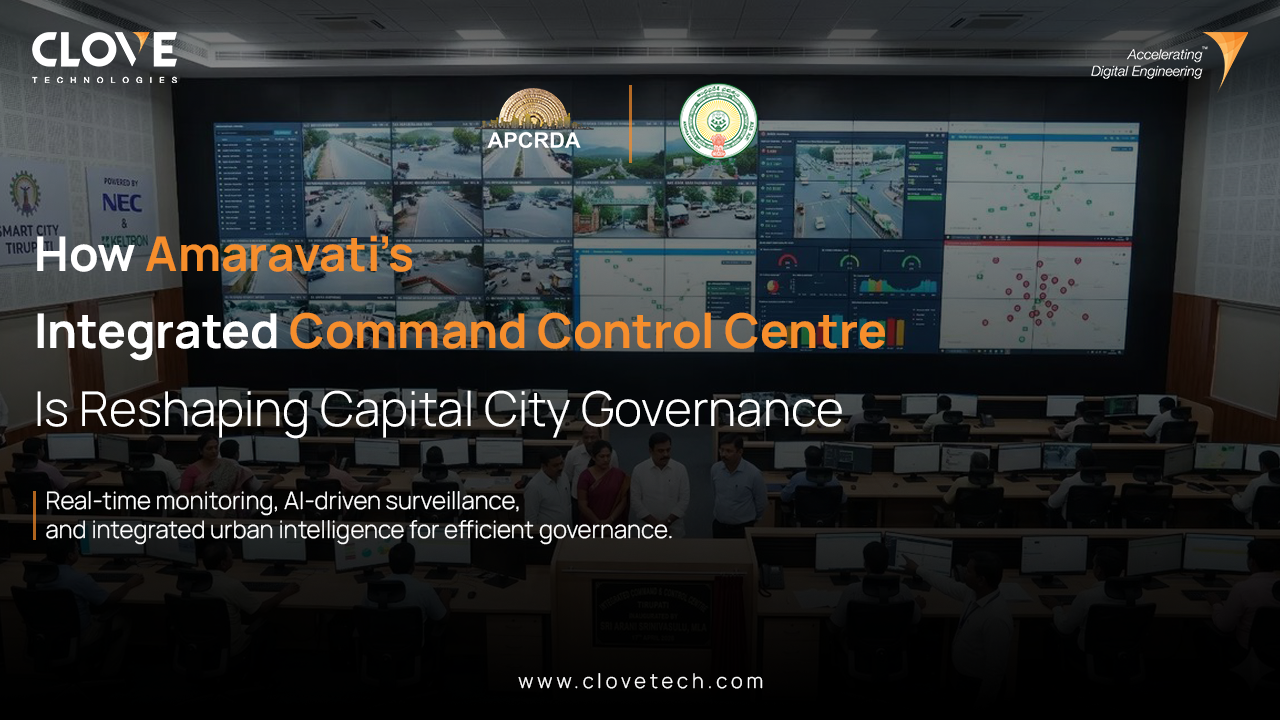
The same idea works when it comes to creating a digital twin for ICCC (integrated command control center) solutions for smart cities models that should provide answers to planners through simulating various operational situations (traffic rerouting, utility load, flood management).
Ready to see what a real digital twin not a metaverse demo could do for your assets? [Talk to Clove Technologies Digital Twin team →]
Is a digital twin part of the metaverse?
Not by default. A digital twin is a standalone, data-driven virtual replica of a physical asset. It can be accessed through an immersive “industrial metaverse” interface, but that’s an optional layer, not a requirement.
Do I need metaverse technology to build a digital twin?
No. A functional digital twin for predictive maintenance, asset monitoring, or facility management runs on BIM data, IoT sensors, and a 3D model with no headset or immersive environment required.
What’s the difference between a digital twin and a virtual twin?
The terms are used inconsistently across the industry. Generally, “digital twin” refers to a live, sensor-connected model, while “virtual twin” is used by some vendors to describe a more simulation- and visualization-heavy variant. Ask any vendor to define their specific usage before comparing platforms.
Is digital twin technology still relevant after the metaverse hype cooled?
Yes, digital twin adoption in infrastructure, utilities, and smart cities has continued to grow independently of consumer metaverse trends, because its value was never tied to mass consumer adoption of immersive technology.
Is a “metaverse digital twin” the same as a regular digital twin?
No. A metaverse digital twin (or industrial metaverse layer) is an optional immersive access point built on top of a digital twin’s data that delivers a virtual twin experience for remote collaboration or training. The underlying digital twin itself works fully without it.
How does Clove Technologies approach digital twin projects differently?
Clove builds digital twins on verified BIM, GIS, LiDAR, and Scan to BIM data, structured around four practical pillars Asset Intelligence, IoT Monitoring, Predictive Maintenance, and Facility Management so the output is an operational tool for asset owners and city planners, not a visualization exercise.
Discover more of our innovative blogs

Top MEP BIM Service Provider in Texas for Electrical, Plumbing & HVAC Systems
Digital Twins and the Metaverse: Exploring New Opportunities in AECO
How ICCC Technology Is Revolutionizing Governance in Amaravati
10 Key Benefits of Using Electrical BIM in MEP Projects
Let's Talk
Let’s discuss your requirements and see how our expertise can help on your next project.